
If your principal pops her head into your classroom unannounced, what do you hope she sees? Something hands-on, right? You want your students actively participating in their learning – because hands on is minds on. At the very least they should be engaged in a heated discussion. The last thing you want is students just sitting listening to your voice during, I don’t know, perhaps. . . a read aloud. Or do you?
I want to dispel that “hands-on” equals “minds-on” myth right now. Hands on activities do not always equal minds on. For example, there are many STEM activities that are just crafts in disguise.
If you show students examples and give them the same materials, they are building a craft.
Cookbook or confirmation experiments are also not minds on. These are done after students have learned the science. For example, students learn that plants need sunlight and water to grow and then are given step by step instructions for confirming those facts with a “recipe” experiment. Students are just going through the motions.
I also want to dispel the myth that students who are sitting quietly aren’t learning. How do we know that students are benefitting from activities like read alouds if we can’t directly see what is happening inside their brains?
Research, that’s how.
And boy, oh boy, the research is wide and deep when it comes to reading aloud. I’m going to share an overview below and I’ve summarized it in a Research Round Up brief you can download for free on StarrMatica’s website. I encourage you to keep several copies handy to provide to parents, principals, and colleagues who pop in while you are reading aloud. Because I was a classroom teacher (shout out to fourth grade!), I know it can feel like you are being caught “taking a break” by “just reading aloud” to your class.
You are not.
You are doing important, essential, brain building work. And now you can prove it.
Read Aloud Benefit #1: A Bigger Brain For Life
Reading aloud physically changes the shape of a child’s brain – permanently. Not only does it strengthen neural connections, it increases brain volume and thickness. Reading aloud builds bigger brains!
Furthermore, the benefits of building stronger brains in childhood have been shown to result in better cognitive function in old age. That means choosing to read aloud to your students today will benefit them for a lifetime.
Read Aloud Benefit #2: A Larger Vocabulary
Children who are read aloud to encounter words they never would via speech alone. A 2015 study out of Indiana University-Bloomington showed that if a child hears two picture books read aloud a day they would be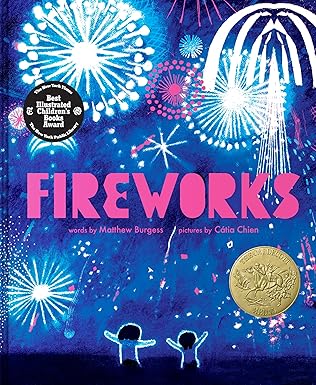 exposed to more than 438,000 words per year, most of which they would not hear in daily conversation.
Words like aghast and grimace. Pick up a picture book near you – hopefully you have one near you (I do!) Read a few pages and identify a few words you don’t use in your daily language.
Next to me was the recent Caldecott Medal winning: Fireworks by Matthew Burgess. In lyrical language that immerses us in a summer day, the author exposes readers to rickety, streaking, bodega, hydrant, and onlookers.
Also close at hand was the creative and captivating Café at the Edge of the Woods by Mikey Please. Because this is a book that takes place in a restaurant, words included: cuisine, clientele, nincompoop, subtle, suspicious, fondue, porcelain, and artichoke.
It is no wonder studies show that reading aloud exposes children to more complex vocabulary than adult to child speech.
Read Aloud Benefit #3: More Robust Background Knowledge
The Science of Reading has spotlighted the importance of background knowledge in our students’ ability to comprehend what they read. In a future blog post, I’m going to talk about building background knowledge authentically, not just stuffing our kids heads full of facts to bump their reading comprehension for a test. We can read aloud nonfiction text sets to build useful knowledge intentionally that is aligned with student-centered three-dimensional science instruction.
Read Aloud Benefit #4: “Turbocharged” Visual Imagery, Comprehension, and Language Development
Brain scans show visual and language areas of the brain light up like fireworks when children are read aloud to. It is the single greatest “brain building” activity we can do with our students. And not just our elementary students. Studies show that reading books aloud to middle school students, that are beyond their independent reading level, increased their reading comprehension. Students not only hear new vocabulary, they hear syntax – how complex sentences are put together in ways more complex than everyday speech.
Read Aloud Benefit #5: Increased Empathy and Creativity
Reading aloud not only helps your students intellectually, but it also builds their social and emotional skills. Research shows that as little as two weeks reading aloud books that model empathy and creativity improve those skills in young children. Small investments of time can make a big impact!
Read Aloud Benefit #6: Reduced Pain and Stress
Do your students seem stressed out? Research shows that reading aloud increases oxytocin and positive emotions PLUS decreases cortisol and pain. If reading aloud can help hospitalized children to feel better, imagine what it can do for your students.
Read Aloud Benefit #7: Awareness of Possibilities
When my youngest son was three, we read When Sue Found Sue by Toni Buzzeo. From that day forward, he has wanted to be a paleontologist. How else would a three year old know digging up dinosaur bones was even a thing? Imagine reading a picture book biography a day to your students. You would be exposing them to 180 STEM careers in a school year! Beyond career possibilities, picture books hold up mirrors so students can see themselves reflected back. Other books provide windows so students can imagine and empathize with the lives of others. Some of our students have rich and varied experiences outside our classroom walls, others do not. Picture books can serve to level the playing field by putting a world of information at the fingertips of all our students.
 Read Aloud Benefit #8: A Life Raft In Your Day
And last but not least, reading aloud can be a life raft in your day. It gives you a minute to pause, catch your breath, and enjoy a shared experience with students.
In my next post, I’ll talk about when to read aloud in the context of your day. (Preview: I’m a fan of the “sprinkle method!”) In the meantime, be sure to download the Read Aloud Research Round Up, which details the research studies shared in this post, and like StarrMatica’s Facebook page to see specific nonfiction picture book read aloud recommendations related to this post.